Show Call Times Explained: Load-In, Doors, Set Times and Curfew
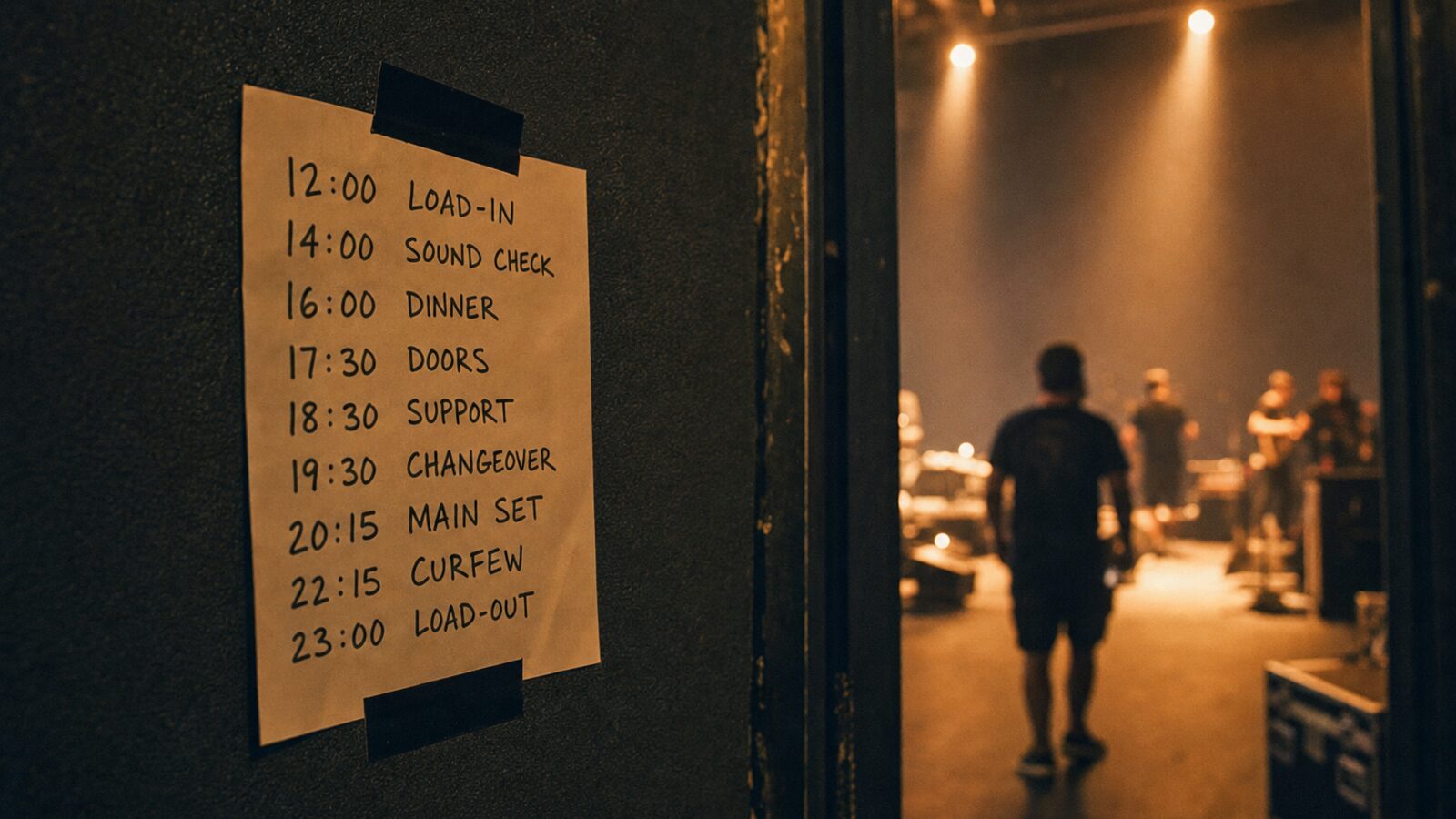
A call time is when a particular person or group must be at the venue and ready to work. Doors is when the audience is let in, set times are when each act plays, and curfew is the latest time the show (or the venue's activity) is allowed to run. On a show day these times are built backward from curfew and forward from load-in, so that every act gets its soundcheck, the doors open on time and the headliner finishes before the hard stop.
The exact times vary every night with the venue, the city and the bill. What stays the same is the logic that connects them.
The vocabulary of a show day
Before looking at how a schedule fits together, here are the terms you will see on a day sheet. A day sheet is the one-page (or one-screen) schedule for a single day that the tour manager sends to everyone on the tour; see what is a day sheet for more.
- Bus call / lobby call: when the touring party must be on the bus or in the hotel lobby ready to leave.
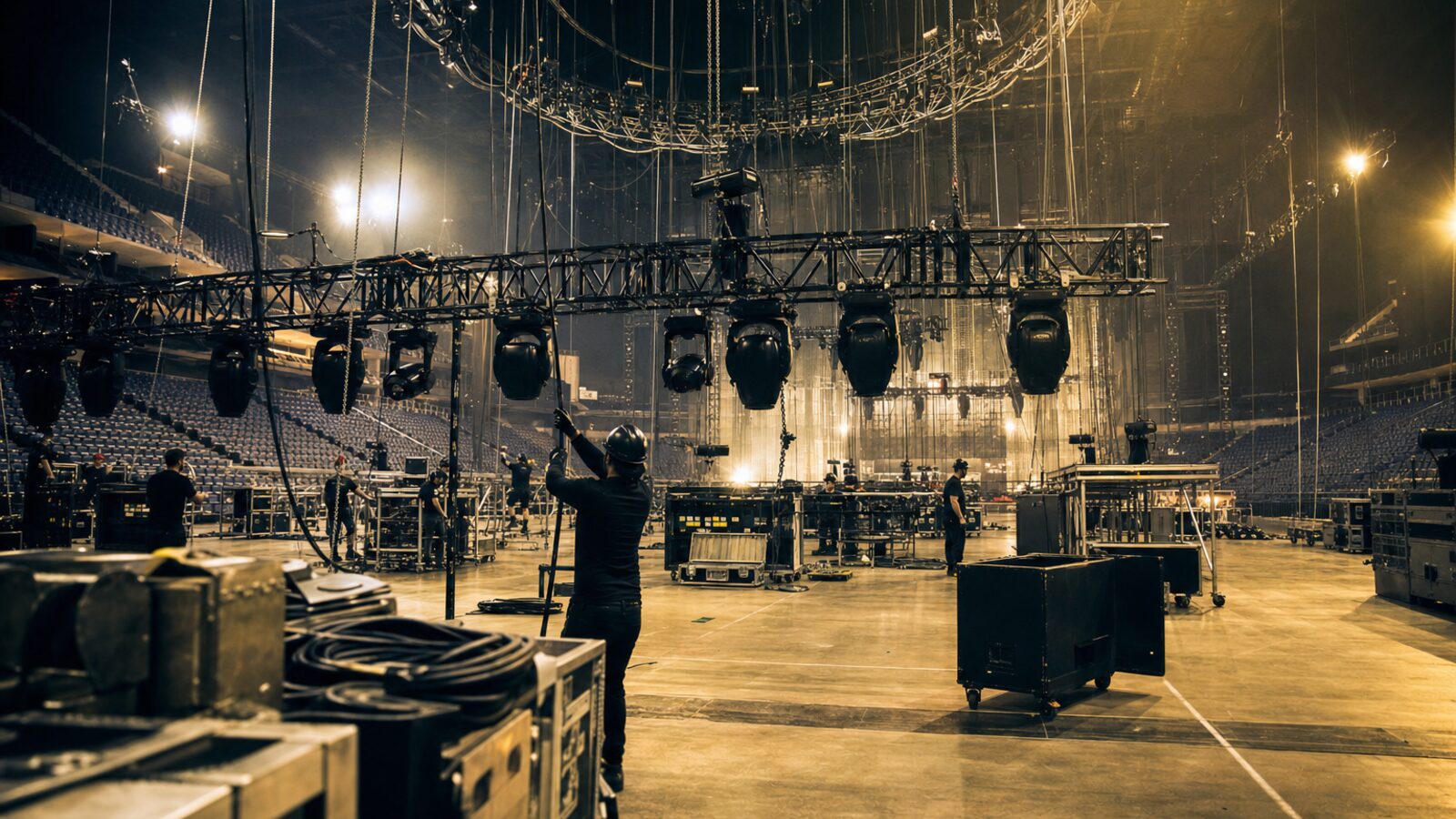
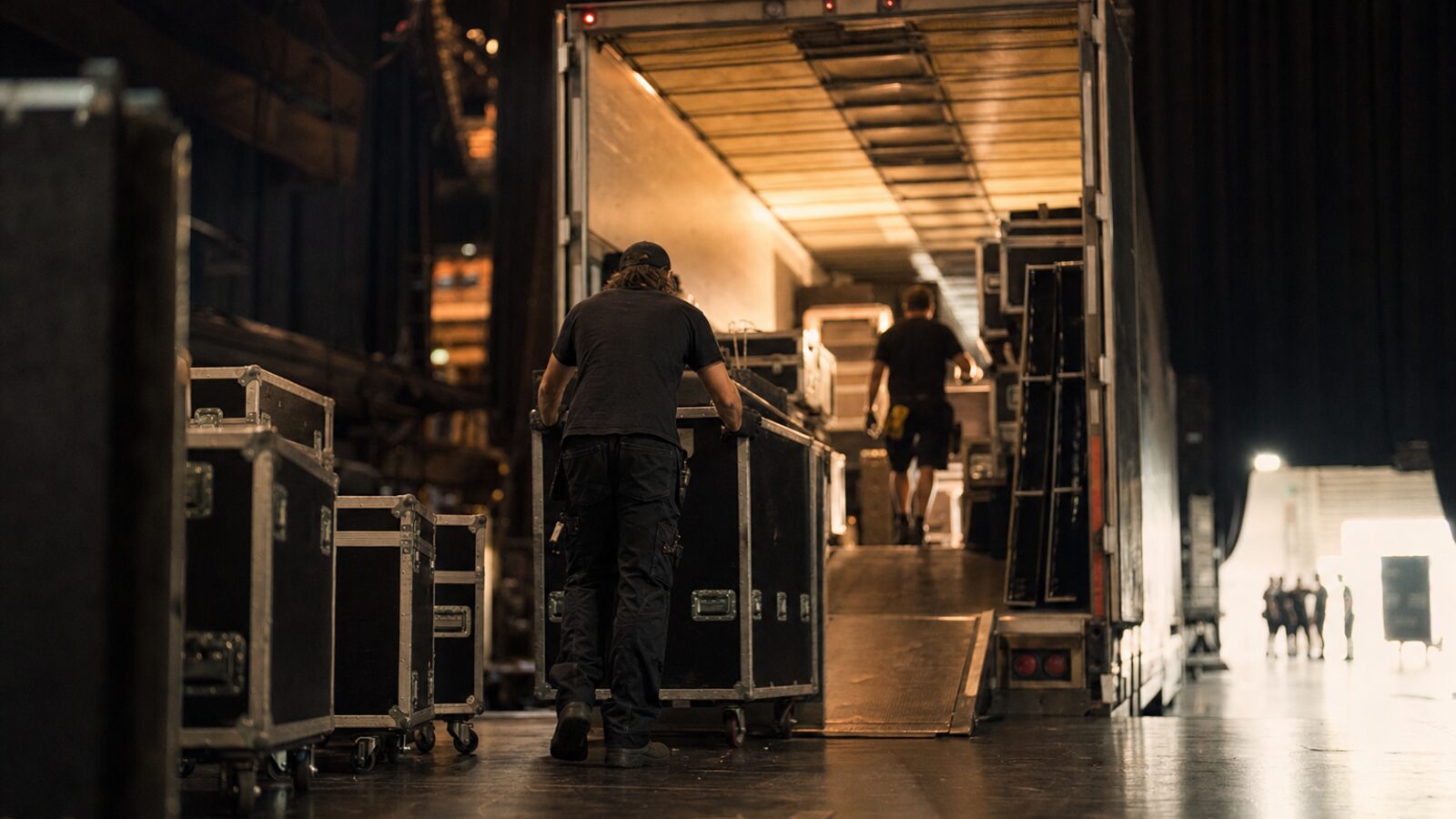
- Load-in: when gear starts coming off the truck, trailer or van and into the venue.
- Call time: when a specific person or group is due to start work. Production and audio crew usually have the earliest calls; band calls tend to be later.
- Local crew call: when the venue's stagehands or loaders start.
- Soundcheck: when the band plays on stage so the engineers can set levels and monitor mixes.
- Line check: a quicker check that every input is working, often used when a full soundcheck is not possible.
- Doors: when the venue opens to the public.
- Set times: the start and finish times for each act.
- Changeover: the gap between acts for clearing one setup and preparing the next.
- Curfew: the hard stop for the show, set by the venue and sometimes by local rules.
- Load-out: when gear is struck and packed back onto the vehicles after the show.
- Settlement: the meeting after (or near the end of) the show where the money is counted and agreed with the promoter.
How the times connect
A show day has two fixed points: the access time (when you can get into the venue) and the curfew. Everything else has to fit between them.
Working backward from curfew
Most tour managers start at the end of the night:
- Curfew is fixed by the venue.
- Headliner set finishes at or before curfew. Many tour managers leave a few minutes of buffer, and plan for encores within the set length.
- Changeover before the headliner.
- Support set(s) before that, each with its own changeover.
- Showtime, when the first act starts.
- Doors before showtime, with enough time to get the audience in.
Working forward from load-in
Then they plan the start of the day:
- Load-in begins when the venue gives access and local crew are called.
- Setup: PA and lighting (if carried), then backline and stage.
- Headliner soundcheck first, because their gear is set at the back of the stage and will stay there.
- Support soundchecks after, in reverse order of the running order, so the opener's gear ends up at the front and ready to go.
- Stage cleared and reset for doors.
The gap between the end of the last soundcheck and doors is where schedules usually get squeezed. If load-in starts late, soundchecks get shortened, and the openers often lose theirs entirely and get a line check instead.
An illustrative show-day schedule
The times below are an example for a club or theater show with one support act. They are illustrative only; real schedules depend on the venue's access times, curfew, the size of the production and the deal.
| Time (example) | What happens |
|---|---|
| 09:00 | Bus arrives, production and crew call |
| 10:00 | Local crew call, load-in begins |
| 13:00 | Backline set, line check |
| 15:30 | Headliner soundcheck |
| 17:00 | Support soundcheck |
| 17:45 | Stage reset for doors |
| 18:00 | Crew dinner |
| 19:00 | Doors |
| 20:00 | Support set |
| 20:30 | Changeover |
| 21:00 | Headliner set |
| 22:30 | Headliner off, curfew 23:00 |
| 22:30 | Load-out begins, settlement |
| 01:00 | Bus call |
Notice how each block depends on the one before. If load-in starts an hour late, every soundcheck moves, crew dinner gets compressed, and doors cannot move because tickets and the public already have the time. Our walkthrough of the anatomy of a show day covers what happens in each of these blocks in more detail.
Call times: who is called when
Different people have different call times, and getting this right saves a lot of hours and goodwill.
- Production crew (production manager, riggers, lighting and audio crew) usually have the earliest call, because setup has to happen before anything else.
- Backline techs are called once there is a stage to work on.
- Local crew are called for load-in and again for load-out. The number of hands and their minimum call lengths are set in the advance and, in some venues, by union or house rules.
- Band members are often called just before soundcheck rather than at load-in.
- Support acts usually have a later call, timed for their soundcheck or line check.
- Merch seller is called early enough to count in stock and set up the stand before doors.
- Drivers may have a call that reflects their rest requirements. Rest and driving-hours rules vary by country and vehicle type, so plan around them rather than through them.
What "on time" means
On most tours, being on time for your call means being ready to work at that time, not arriving at that time. If your call is at 10:00, you are in the building, credentials on, coffee in hand, a few minutes before.
Doors, set times and the audience
The public-facing times are doors and, often, set times. Once they are announced they are hard to change.
- Doors are set by the venue and promoter, and are printed on tickets.
- Set times may or may not be published. Some venues post them on the day; some artists prefer not to, so the audience arrives for the openers.
- The gap between doors and showtime gives people time to get through security, buy drinks and visit the merch stand. It varies widely by venue.
- Late doors happen when soundcheck runs over or the stage is not reset. They create a queue outside and a compressed evening inside, so most tour managers protect doors time above almost everything else.
Curfew: the line you do not cross
Curfew is the latest time the show can run. It may be set by the venue's license or neighbors agreement, by local noise rules, by the building's other events, or by union staff overtime thresholds. It is agreed in the advance and is usually written into the contract.
What happens if you go over depends on the venue and the agreement. Common consequences include overtime charges that come out at settlement, fines under the venue's terms, the house cutting power or sound, and a damaged relationship with the venue. That is why set lengths are calculated from curfew rather than from showtime.
Some venues also have a load-out curfew or a time by which the trucks and bus must leave the dock. Check this in the advance, especially in city-center venues.
Keeping the schedule on track
A schedule is only as good as the way it is run on the day.
- Advance every time. Confirm access time, curfew, doors and changeover length with the venue before arrival.
- Share one version. Everyone, including support acts and local crew, should see the same times. Print the schedule and post it at the dock, the stage and the dressing rooms.
- Build in buffer. Leave margin between soundcheck and doors and between the headliner's finish and curfew.
- Communicate changes immediately. If something moves, tell everyone affected, not just the person in front of you.
- Protect the fixed points. Doors and curfew rarely move. Soundcheck length and dinner are where the flexibility usually is.
When times shift, the hardest part is making sure everyone sees the change. Tools like Conductour keep the day's schedule on everyone's phone, so a moved soundcheck reaches the right people without a group-chat scramble.
Learn the vocabulary, work backward from curfew and forward from load-in, and you will be able to read, and eventually build, any show-day schedule.
Frequently asked questions
What does call time mean at a concert? +
Call time is the time a specific person or group is expected to be at the venue and ready to work. Crew, band, opening acts and local stagehands often have different call times on the same day. Being on time for your call usually means arriving early enough to start working at that time, not walking in the door.
What is the difference between doors and showtime? +
Doors is when the venue opens to the audience. Showtime is when the first act starts. There is usually a gap between them so people can get in, buy drinks and merch, and find their spots; how long that gap is depends on the venue and the show.
What happens if a show goes past curfew? +
It depends on the venue and the deal. Consequences can include overtime charges for venue staff, fines under the venue's agreement or local rules, the sound being cut, or problems with the venue for future bookings. That is why set times are worked backward from curfew and the headliner's set length is protected.
What is a changeover? +
A changeover is the time between one act finishing and the next one starting, when the first act's gear is cleared and the next act's gear is set and line-checked. Its length is agreed in the advance and depends on how much gear needs to move. Tight changeovers are planned in soundcheck so the next act's gear can be pre-set where possible.
Run your next tour on Conductour
Itineraries, show cues, travel, and crew — one timeline the whole team can trust.
Start for free