How to Build a Tour Budget: Line Items, Income and Break-Even
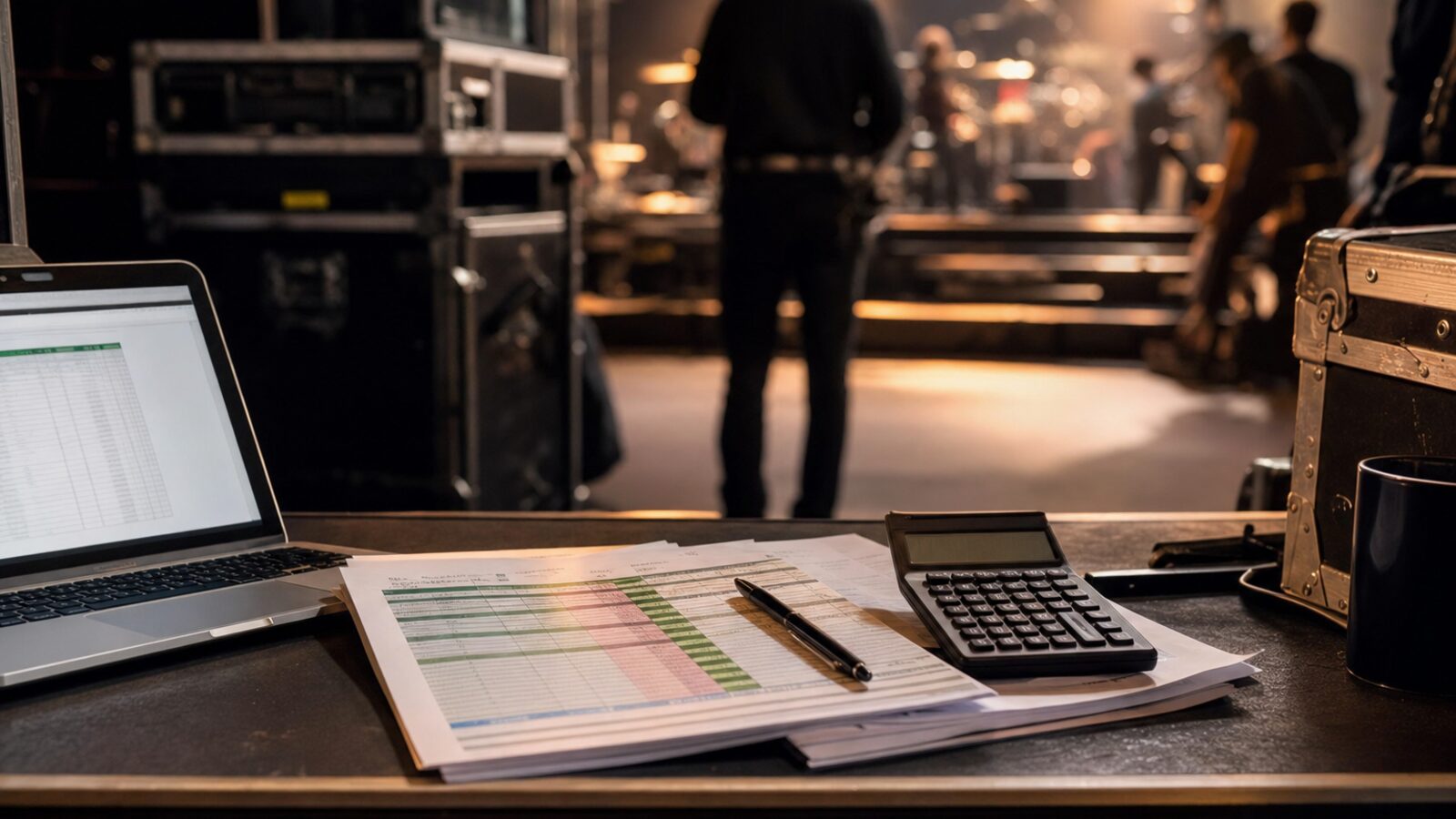
A tour budget is a show-by-show forecast of every cost of getting the artist on the road and every source of income that tour will earn, so you can see before you commit whether it makes or loses money. You build it by listing your fixed weekly costs (people, vehicles, gear), your per-show costs (hotels, fuel, local expenses), and your expected income per date, then comparing the totals to find break-even: the point where income covers cost.
That is the whole idea. The craft is in not forgetting anything, being honest about income, and keeping the budget alive once the tour starts.
Why the budget comes before the routing is final
It is tempting to treat the budget as paperwork you do after the dates are booked. In practice, the budget is how you decide which dates to book. A guarantee that looks good in isolation can lose money once you add the drive, the extra hotel night and the day off it forces into the schedule.
If you are still putting the tour together, run a rough budget alongside the routing. Our guide to routing tours and travel days explains why the order of cities affects cost so much.
A useful habit: every time an offer comes in, ask "what does this date cost us to play, including getting there and getting to the next one?" The budget gives you that answer in minutes instead of guesses.
Set up the structure first
Before you put in a single number, decide how the budget is organized. Most tour budgets use some version of this layout:
- One column per show day, day off and travel day. Every day costs money, even the ones without a show.
- Rows grouped by category: income, people, travel, accommodation, production, commissions and fees, overhead, contingency.
- A weekly or tour-total summary that rolls everything up.
- A "budget vs. actual" section you fill in as receipts come in.
A spreadsheet is fine for most tours. What matters is that it is one shared file with one owner, usually the tour manager or the artist's business manager, rather than three versions in three inboxes.
Fixed vs. variable costs
It helps to tag each line as fixed or variable:
- Fixed (weekly or per tour): wages, vehicle rental, backline rental, insurance, production rental packages.
- Variable (per day or per show): hotels, fuel, tolls, parking, local crew, catering not covered by the venue, per diems.
Fixed costs tell you your weekly "burn," the amount the tour spends whether or not there is a show that night. That number is what makes days off expensive.
The expense side: every line to include
Here is a working list of line items. Not every tour has all of them, but it is easier to delete a row than to discover one at settlement.
People
- Band wages or fees. Salaried players, session musicians on a weekly rate, or a per-show fee.
- Crew wages. Tour manager, production manager, front of house (FOH) engineer, monitor engineer, backline techs, lighting designer, merch seller, drivers.
- Per diems. A daily allowance for meals and incidentals, paid per person for every day on the road, including days off.
- Buyouts. Cash paid in place of a meal or other hospitality the venue would otherwise provide. If you advance a meal buyout instead of catering, note whether it is income to the band or a pass-through to the crew.
- Rehearsal and prep days. Wages for production rehearsals before the tour starts are easy to forget.
- Payroll costs. Depending on how people are engaged, there may be employer taxes, payroll service fees or benefits. This varies by country and by whether crew are employees or contractors; ask your accountant.
Travel
- Vehicles. Van, sleeper bus, splitter, truck or trailer rental, usually charged weekly or daily. Buses often carry extra charges such as driver fees, driver hotel rooms, overage mileage and generator fuel; read the quote line by line.
- Fuel, tolls and parking. Estimate fuel from total mileage on the routing.
- Flights. Including bag and excess-equipment fees, which can be significant for instruments and cases.
- Ground transport for fly dates: airport transfers, local cars, runners.
- Freight and shipping for gear that travels separately.
Accommodation
- Hotels per night, with the room count from your rooming list. Our post on tour hotels and rooming lists covers how to plan rooms.
- Day rooms for bus tours, where the crew uses a room for showers between arrival and checkout.
- Driver rooms. Bus and truck drivers sleep during the day, so they usually need a hotel room even on bus tours.
Production
- Backline rental: amps, drums, keyboards, if you are not carrying your own.
- Sound, lighting and video rental if you are carrying a production package rather than using house equipment.
- Consumables: strings, sticks, drum heads, batteries, gaff tape, spare cables.
- Local crew and labor that is not covered by the deal. Often this is a venue expense deducted at settlement, so check the offer.
- Production rehearsals: room hire, gear and power.
Commissions and fees
The artist's team is usually paid a percentage of income, and that comes out before anyone sees a profit. Typical entries:
- Booking agent commission, usually calculated on show income.
- Artist manager commission.
- Business manager or accountant fees.
The percentages and what they are calculated on (gross vs. net, guarantees only vs. all income) are set in each contract and vary, so use the actual terms from your agreements rather than a rule of thumb.
Overhead and admin
- Insurance: equipment, liability, and sometimes cancellation or medical cover for international legs.
- Work permits, visas and carnets for international touring. Rules change often, so check official sources for each country. An ATA carnet is a customs document that lets you temporarily import gear without paying duty; it has its own fees and a security deposit or bond.
- Withholding tax. Many countries withhold tax from foreign performers' fees at source. Whether it applies, at what rate and whether it can be reduced depends on the country and any tax treaty, so get professional advice before you count on the full guarantee.
- Phone, data and software subscriptions used for the tour.
- Bank and currency exchange fees when you are paid in cash or foreign currency.
Contingency
Always include a contingency line: money set aside for things that will go wrong but you cannot predict, like a breakdown, a lost bag, a replacement amp or a cancelled flight. Many tour managers set it as a percentage of total costs; choose a figure you are comfortable defending and do not raid it to make the bottom line look better.
The income side: estimate honestly
Income is where optimistic budgets go wrong. Stick to what the deal actually guarantees and treat everything else as upside.
Show income
Each show's income depends on the deal type:
- Flat guarantee: a fixed fee regardless of ticket sales.
- Door deal or percentage: a share of ticket revenue, after agreed expenses.
- Versus deal: the artist receives the guarantee or a percentage of net box office, whichever is greater.
For budgeting, use the guarantee as your base number. Only budget a percentage payout if you have a realistic sales forecast, and label it as an estimate. Our guide to how show settlement works explains how the final number is worked out on the night.
Other income
- Merch. Budget net merch income, not gross sales: subtract cost of goods, venue merch fees, the merch seller's wages and any sales tax. See merch on tour: how it works.
- Tour support from a label, if any, and whether it is recoupable.
- Sponsorship or VIP packages, with their own fulfillment costs deducted.
- Buyouts received from venues, if they are paid to the artist.
Deposits and timing
Many guarantees are paid partly as a deposit in advance and the rest at settlement. Track when money actually arrives, not just how much. A tour can be profitable on paper and still run out of cash in week two if bus deposits and flights are due before any guarantees are paid.
Finding break-even
Once both sides are filled in, the arithmetic is straightforward:
Total income − total costs (including commissions and contingency) = tour profit or loss.
It is also useful to break it down per show. Divide your fixed weekly costs across the shows that week to get each date's share of the running costs, then add that date's own variable costs. Compare the result with the date's expected income. Dates that fall short are not automatically bad; a weaker date might be the only way to fill a long drive. But you should know which dates are carrying the tour.
An illustrative example
The figures below are invented round numbers to show the math. They are not typical costs for any tour level.
| Line (illustrative only) | Week total |
|---|---|
| Wages and per diems | 10,000 |
| Vehicle, fuel and tolls | 4,000 |
| Hotels | 3,000 |
| Production and consumables | 1,500 |
| Commissions (from contracts) | 2,000 |
| Contingency | 1,000 |
| Total costs | 21,500 |
| Guarantees (5 shows) | 20,000 |
| Net merch | 3,000 |
| Total income | 23,000 |
In this made-up week the tour clears its costs, but note that it only does so because of merch. Lose a show or have a weak merch week and it is underwater. That is exactly the kind of insight a budget exists to show you.
Running the budget on the road
The budget is not finished when the tour starts; that is when it becomes useful.
- Log actuals daily or at least weekly. Receipts, fuel, per diem payouts and settlement figures all go into the actual column.
- Reconcile after each settlement. Compare the settled amount with what you budgeted, and note the reason for any difference (lower walk-up, extra deductions, a production charge).
- Keep a float log if you carry cash: what came in at settlement, what went out as per diems or buyouts, and what is left.
- Flag variances early. If fuel is running over in week one, the rest of the tour will too. Tell the manager now, not at the end.
- Close out properly. After the tour, produce a final reconciliation for the artist's management and accountant, with receipts.
Keeping the money side tidy is much easier when the logistics side is tidy too. When the itinerary, hotel bookings and crew list all live in one place, as they do in tools like Conductour, you are far less likely to miss a driver room or a day-off hotel when you budget.
Common budgeting mistakes
- Forgetting days off. Wages, per diems, vehicles and hotels keep running on days without a show.
- Budgeting gross merch. Net is what you actually keep.
- Ignoring commissions until the end, when they quietly erase the profit.
- Assuming the full guarantee arrives. Withholding taxes, settlement deductions and currency fees reduce it.
- No contingency, or a contingency that gets spent on planned costs.
- Multiple versions of the budget in different inboxes. Keep one file, with one owner.
A good tour budget is not complicated. It is complete, it is honest about income, and someone keeps it up to date until the last receipt is filed.
Frequently asked questions
What should a tour budget include? +
At minimum: crew and band wages, per diems, transportation, fuel, hotels, production and backline, insurance, commissions, and a contingency line. On the income side, list every show's guarantee or expected share, plus merch and any other revenue. Build it show by show so you can see which dates carry the tour and which cost money.
How far in advance should you budget a tour? +
Start a rough budget before you confirm routing, because it tells you which offers are worth taking. Refine it as dates confirm and quotes come in, and keep updating it on the road with actual spend. A budget that is only built once is a guess; one that is tracked against actuals is a management tool.
What is a per diem on tour? +
A per diem is a daily cash allowance paid to band and crew to cover meals and incidentals on the road. The amount is set by the artist's team or by crew agreements and varies widely by tour level and territory. It is usually budgeted per person, per day, for every day someone is on the road, including days off and travel days.
How do you calculate break-even for a tour? +
Add up your total tour costs, including commissions and contingency, and compare them with your total expected income. Many managers also calculate break-even per show to see how many tickets or what guarantee a date needs to cover its share of the tour's running costs. The point where income equals cost is break-even; everything above it is profit.
Run your next tour on Conductour
Itineraries, show cues, travel, and crew — one timeline the whole team can trust.
Start for free